

Unveiling AMD Zen 6 CPU Core ISA: Discover AVX512 FP16, VNNI INT8 & More
The anticipation for AMD’s next-gen Zen 6 CPU architecture is building, with recent developments sparking excitement amongst enthusiasts and tech analysts. A significant update to the GCC compiler has introduced support for this upcoming powerhouse, providing a glimpse into the advanced technologies it will incorporate.
Unveiling AMD Zen 6 Architecture
The latest patch for the GCC Compiler, titled “Add AMD znver6 processor support,” marks a milestone by integrating support for AMD’s Zen 6 core architecture. This patch not only confirms the architecture’s existence but also highlights its initial Instruction Set Architecture (ISA). Key features include AVX512_FP16, AVX_NE_CONVERT, AVX_IFMA, and AVX_VNNI_INT8. This advanced support heralds a new era of performance enhancements, with AVX-512 FP16 promising to elevate future Zen architectures to unprecedented levels.
![[PATCH] Add AMD znver6 processor support email with details on AVX512_BMM instructions and CPUID 8000_0021.](https://cdn.wccftech.com/wp-content/uploads/2025/11/AMD-Zen-6-core-architecture-ISA.png)
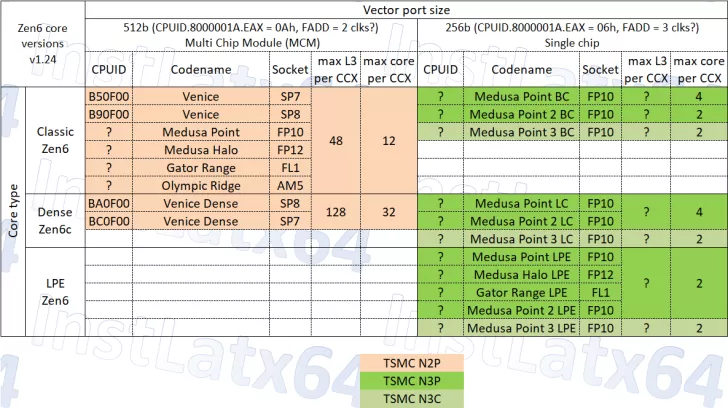
Insights also point to the existence of a new Zen 6 CPU ID, B80F00, likely part of several Zen 6 families, including the anticipated server Venice lineups in Classic and Dense variants. The Classic lineup is expected to feature up to 12 cores per CCX, while the Dense variant will boast 32 cores per CCX, pushing the boundaries with up to 256 cores, 8 CCXs, and a massive 1024 MB of L3 cache.
The Road Ahead for AMD Zen 6
The Zen 6 architecture is not limited to server solutions. It will extend into the consumer market with at least four client families, such as the high-end AM5 “Olympic Ridge,” featuring up to 24 cores and 48 threads. Additionally, the Medusa Point and Gator Range APU lines are expected to harness the TSMC N2P process node, while monolithic offerings will utilize TSMC N3P/N3C nodes. With AMD’s Financial Analyst Day on the horizon, enthusiasts are eagerly awaiting potential teasers, although substantial announcements are projected for CES 2026.
AMD Zen CPU / APU Roadmap:
| Zen Architecture | Zen 7 | Zen 6C | Zen 6 | Zen 5 (C) | Zen 4 (C) | Zen 3+ | Zen 3 | Zen 2 | Zen+ | Zen 1 |
|---|---|---|---|---|---|---|---|---|---|---|
| Core Codename | TBA | Monarch | Morpheus | Nirvana (Zen 5) Prometheus (Zen 5C) |
Persphone (Zen 4) Dionysus (Zen 4C) |
Warhol | Cerebrus | Valhalla | Zen+ | Zen |
| CCD Codename | TBA | TBA | TBA | Eldora | Durango | TBC | Brekenridge | Aspen Highlands | N/A | N/A |
| Process Node | TBA | 3nm/2nm? | 3nm/2nm? | 3nm | 4nm | 6nm | 7nm | 7nm | 12nm | 14nm |
| Server | TBA | EPYC Venice (6th Gen) | EPYC Venice (6th Gen) | EPYC Turin (5th Gen) | EPYC Genoa (4th Gen) EPYC Siena (4th Gen) EPYC Bergamo (4th Gen) |
N/A | EPYC Milan (3rd Gen) | EPYC Rome (2nd Gen) | N/A | EPYC Naples (1st Gen) |
| High-End Desktop | TBA | TBA | TBA | Ryzen Threadripper 9000 (Shamida Peak) | Ryzen Threadripper 7000 (Storm Peak) | N/A | Ryzen Threadripper 5000 (Chagal) | Ryzen Threadripper 3000 (Castle Peak) | Ryzen Threadripper 2000 (Coflax) | Ryzen Threadripper 1000 (White Haven) |
| Mainstream Desktop CPUs | TBA | TBA | Ryzen **** (Olympic Ridge) | Ryzen 9000 (Granite Ridge) | Ryzen 7000 (Raphael) | Ryzen 6000 (Warhol / Cancelled) | Ryzen 5000 (Vermeer) | Ryzen 3000 (Matisse) | Ryzen 2000 (Pinnacle Ridge) | Ryzen 1000 (Summit Ridge) |
| Enthusiast Mobile CPUs | TBA | TBA | Ryzen **** (Gator Range) | Ryzen 9000HX (Fire Range) | Ryzen 7000HX (Dragon Range) | N/A | N/A | N/A | N/A | N/A |
| Mainstream Desktop . Notebook APU | Ryzen AI 500 (Sound Wave)? | Ryzen AI 500 (TBA) | Ryzen AI 400 (Medusa Point / BB) | Ryzen AI 300 (Strix Point) Ryzen *** (Krackan Point) |
Ryzen 7000 (Phoenix) | Ryzen 6000 (Rembrandt) | Ryzen 5000 (Cezanne) Ryzen 6000 (Barcelo) |
Ryzen 4000 (Renoir) Ryzen 5000 (Lucienne) |
Ryzen 3000 (Picasso) | Ryzen 2000 (Raven Ridge) |
| Low-Power Mobile | TBA | TBA | TBA | Ryzen *** (Escher) | Ryzen 7000 (Mendocino) | TBA | TBA | Ryzen 5000 (Van Gogh) Ryzen 6000 (Dragon Crest) |
N/A | N/A |