

Revolutionary AMD RDNA 5 Radeon GPUs Set for Mid-2027 Launch with Cutting-Edge TSMC N3P Technology
Exciting developments are on the horizon for AMD enthusiasts, as whispers in the industry suggest a mid-2027 launch for the next-generation “RDNA 5” GPU family. This eagerly anticipated lineup promises to deliver significant advancements in graphics technology. While 2026 might be a relatively quiet year for AMD Radeon GPU releases, the company appears to be gearing up for a major launch the following year.
Anticipating RDNA 5 and the N3P Node
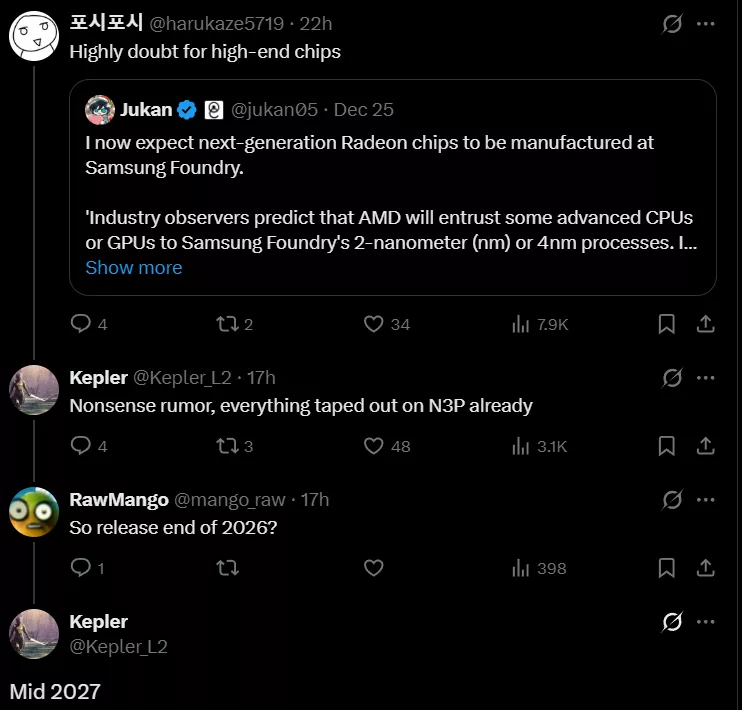
Reports suggest that AMD’s RDNA 5 GPUs will be produced using TSMC’s advanced N3P process technology, marking a significant step forward from the current N4P node utilized in RDNA 4. This new process offers impressive improvements, including 18% higher speeds, 36% lower power consumption, and a 24% reduction in area compared to its predecessor. The GPUs are expected to hit the market by mid-2027, following extensive production preparations throughout the latter half of 2026.
Debunking earlier rumors about Samsung’s involvement, the production is confirmed to be in the hands of TSMC, with AMD’s next-gen lineup already taped out on the N3P node. Enthusiasts can look forward to the integration of new technologies such as Universal Compression, Neural Arrays, and the dedicated Radiance Cores for enhanced ray tracing capabilities.
Technological Innovations and Future Prospects
AMD’s RDNA 5 architecture is set to revolutionize the gaming industry with its cutting-edge features. Universal Compression aims to optimize memory bandwidth usage, while Neural Arrays and Radiance Cores will enhance AI processing and real-time ray tracing, respectively. These technologies are not limited to discrete RDNA 5 GPUs but are also expected to be incorporated in the next-generation Sony PlayStation (Orion) and Microsoft Xbox (Magnus) SoCs.

Speculation abounds about the potential configurations for RDNA 5 GPUs, with some sources hinting at over 12,000 cores and 128 cores per compute unit. The upcoming GPUs, referred to as GFX13 in early Linux Kernel code, are anticipated to enter production by Q2 2026, though this timeline might shift to later in the year.
Meanwhile, the entire GPU industry is closely monitoring the DRAM market due to a supply crisis, impacting everything from RAM to SSD prices. As a result, concrete details about AMD’s upcoming lineup may take time to emerge. There is also a possibility of a RDNA 4 refresh in 2026, though this remains uncertain given the current market scenario.
Potential AMD RDNA 5 / UDNA GPU Configurations
| GPU Die | Navi 5X | Navi 5X | Navi 5X | Navi 5X |
|---|---|---|---|---|
| Positioning | Flagship-Tier | Mid-Tier | Low-Tier | Entry-Tier |
| Max Compute Units | 96 CUs (12288 Cores) | 40 CUs (5120 Cores) | 24 CUs (3072 Cores) | 12 CUs (1536 Cores) |
| Max Memory Bus | 512-384 bit | 384-192 bit | 256-128 bit | 128-64 bit |
| Max VRAM Capacity | 24-32 GB | 12-24 GB | 8-16 GB | 8-16 GB |