

NVIDIA is poised to be the exclusive pioneer for TSMC’s cutting-edge A16 process technology, setting the stage for the next wave of GPU advancements. This strategic move is expected to enhance NVIDIA’s future Feynman GPUs, which will follow the Rubin series slated for 2026 and 2027.
NVIDIA Feynman GPUs Embrace TSMC’s A16 (1.6nm) Breakthrough
Reports suggest NVIDIA remains the sole contender for TSMC’s upcoming A16 process technology. This advancement will form the backbone of NVIDIA’s next-generation GPUs, such as Feynman, slated to succeed the Rubin 2026 and Rubin Ultra 2027 lines. 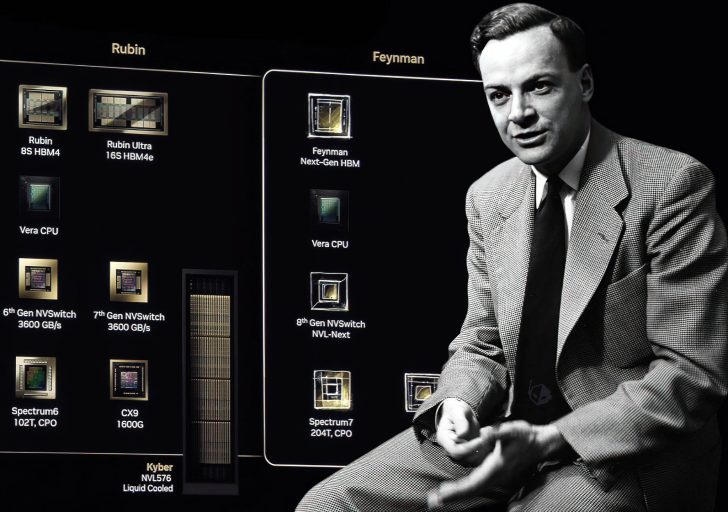
As the demand for AI-related chips surges, NVIDIA is accelerating production of its Blackwell Ultra series, urging TSMC to expedite its P3 plant operations. This facility will be instrumental in manufacturing Rubin chips, leveraging TSMC’s advanced 3nm technology, a notable upgrade from the current Blackwell chips.
The Road Ahead for NVIDIA and TSMC
Jensen Huang, NVIDIA’s CEO, highlighted during GTC US 2025 that the Vera Rubin Superchips are on track for production in 2026, with potential early releases by Q3 of that year. Strong sources reveal NVIDIA remains the exclusive customer for the A16 process, with mass production at the Kaohsiung P3 plant set to commence in 2027, aligning with Apple’s transition into the 2-nanometer generation.
The advanced A16 node promises a leap in performance, with 8-10% speed increases, 15-20% power efficiency improvements, and a 7-10% rise in chip density compared to its predecessor. NVIDIA’s shift from N3P to A16 is poised to deliver substantial advancements. 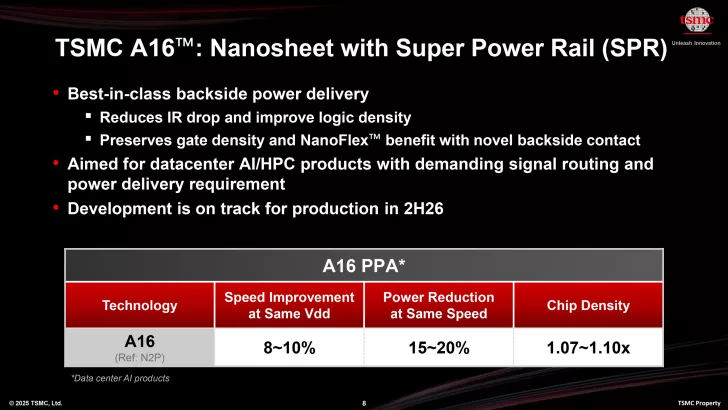
TSMC’s A16 process technology will be a game-changer for NVIDIA’s Feynman GPUs, promising significant performance improvements.
Being the frontrunner for A16, NVIDIA might benefit from priority access and allocation, further solidifying its strategic partnership with TSMC. The collaboration has flourished amid the AI boom, with both companies recently marking the first Blackwell wafer produced on US soil. NVIDIA’s foresight and strategic moves have positioned it as a leader in the AI sector, although challenges from AMD, Microsoft, Google, and others loom on the horizon.
NVIDIA’s Strategic GPU Development Path
| GPU Codename | Feynman | Rubin (Ultra) | Rubin | Blackwell (Ultra) | Blackwell | Hopper | Ampere | Volta | Pascal |
|---|---|---|---|---|---|---|---|---|---|
| GPU Family | GF200? | GR300? | GR200? | GB300 | GB200/GB100 | GH200/GH100 | GA100 | GV100 | GP100 |
| GPU SKU | F200? | R300? | R200? | B300 | B100/B200 | H100/H200 | A100 | V100 | P100 |
| Process Tech | TSMC A16? | TSMC N2P? | TSMC N3P? | TSMC 4NP | TSMC 4NP | TSMC 5nm | TSMC 7nm | TSMC 12nm | TSMC 16nm |
| Memory | HBM4e/HBM5? | HBM4 | HBM4 | HBM3e | HBM3e | HBM2e/HBM3/HBM3e | HBM2e | HBM2 | HBM2 |
| Launch | 2028 | 2027 | 2026 | 2025 | 2024 | 2022-2024 | 2020-2022 | 2018 | 2016 |